📑 On this page
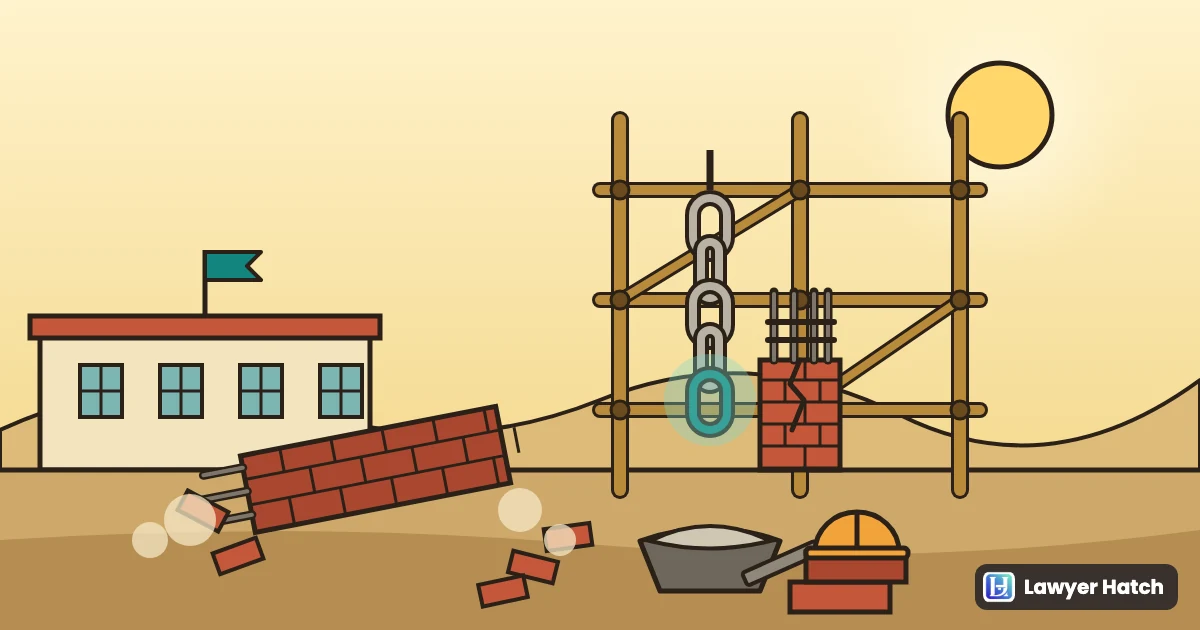
In February 2020 a pillar under construction at an ashram school in Amravati, Maharashtra, collapsed and killed a pupil. The school's President and Superintendent were chargesheeted for culpable homicide not amounting to murder. On 2 November 2026 Justices J.B. Pardiwala and Manmohan quashed that case against them.
The order is not a verdict that nobody is to blame. It shows that before the law blames anyone for a death, it runs them through three checkpoints, and most people in a collapse story fail the second or third.
- Culpable homicide needs intention, or knowledge that death was likely. Believing poor work could cause an accident is not that.
- For death by negligence, even assumed carelessness by the officials was only a necessary condition, not the effective cause.
- On the Court's reading the contractor doing the work is prima facie the one responsible, subject to trial evidence.
- Proceedings were quashed only against the two appellants; the trial can go on against any other co-accused.
- CLAT method: state of mind, then degree of carelessness, then last link in the chain.
Who was in the chain
Every collapse story has an <b>orderer</b> (who decides the work happens), a <b>doer</b> (who does it) and a <b>watcher</b> (placed to see a problem and stop it). The law treats each hat differently. The pillar order sorted people like this.
| Person | Role | What the Court said |
|---|---|---|
| President and Superintendent | Administrators, accused of not ensuring proper construction or taking precautions | Not to face trial. Even if careless, not the effective cause. |
| The contractor and his team | The people who "were actually undertaking the construction" | "Prima facie" responsible, only if he is an accused and trial evidence supports it. |
| Any other accused | Not identified in the order | Trial may proceed "in accordance with law". |
Gate one: did anyone mean it, or know it?
The first question is about the mind. The law sorts states of mind on a ladder, and the rung decides the offence.
| Rung | In the person's mind | Example |
|---|---|---|
| Intention | "I want this person dead." | Covering a pit with sticks and turf so a chosen person falls in. Culpable homicide. |
| Knowledge | "My act is likely to kill, though I do not want that." | Letting a crowd onto a bridge you know is about to give way. Culpable homicide. |
| Recklessness | "I see the danger and hope it won't happen." | Overloading a crane over a busy lane. Death by negligence, if gross. |
| Negligence | "I never thought of it, but a careful person would have." | Leaving a railing unfixed. Criminal only if gross; otherwise a civil claim. |
Notice the word <b>likely</b>. The High Court had reasoned that the officials knew sub-standard material "may cause harm or death". The Supreme Court differed. The contractor could at most be prima facie negligent, knowing poor work "may lead to an accident or a casualty", but that "by itself would not suggest" the appellants knew it "in all probability was likely to cause death".
Knowing an accident is possible is not knowing death is the likely result. Almost every building carries some risk. Knowledge in the criminal sense means the risk of death has moved from possible to probable.
Gate two: was the carelessness bad enough to be a crime?
With no intention and no such knowledge, the question is whether death came from a <b>rash or negligent act</b>. Negligence is common. Criminal negligence is rare.
A shopkeeper who leaves a wet floor unmarked is careless, and a customer who slips can claim damages. The criminal law demands carelessness so severe that it shows disregard for the life and safety of others. The Court put it this way: "rashness and negligence are not the same things." Rashness is running a risk you can see in the hope it will not come true, and the law "does not permit a man to be un-cautious on a hope however earnest or honest that hope may be."
It also held that "the mere failure to attain the standard of care prescribed by the law" is not by itself a criminal act. A breach of duty can make you pay. It does not make you a criminal. The offence of death by negligence does not use the word "gross", but the Supreme Court's doctors' negligence ruling says it must be read as qualified by "grossly".
Gate three: whose act was the last link?
Even a grossly careless person is not always the cause of the death. Gate three asks about the chain of events.
| Label | Plain meaning | Test |
|---|---|---|
| Causa sine qua non | A condition without which the death would not have happened | "But for this, would the death have occurred?" |
| Causa causans | The immediate, effective cause; the last link | "Did this act actually bring about the death, with no one else's act stepping in?" |
| Cause interveniens | A new act that comes in between and breaks the chain | "Did something else become the real cause?" |
For death by negligence the act must be the <b>proximate and efficient cause</b>, without another person's negligence intervening. Two older Supreme Court fact patterns show this.
- The paint factory. A manager let burners run near stored turpentine and varnish in a factory not licensed for that process. A fire killed seven workers. The negligence conviction was set aside, because the immediate cause was a workman pouring turpentine too early. No lapse, no fire, but the manager's lapse was not the last link.
- The learner at the wheel. A man with only a learner's licence drove a jeep with no trainer beside him and a pedestrian died. There must be a direct link between the negligent act and the death, and prosecutors must prove it. Having only a learner's licence did not prove that.
Now the pillar. The Court said "many other factors might have resulted in the unfortunate incident", and "it was the contractor and his team who were actually undertaking the construction". The officials' alleged negligence "cannot be regarded as the causa causans", "although it may be a causa sine qua non".
Run a collapse through the gates
A made-up case. A hoarding on a shop front in an Indore market falls on a windy evening and kills a passer-by. <b>Mr Joshi</b>, the owner, ordered it and took the cheapest quote. <b>Rafiq</b>, the signboard contractor, fixed it with bolts he knew were below the agreed grade. <b>Sunil</b>, Joshi's staff member, saw it wobble that morning and said nothing.
| Gate 1: mind | Gate 2: how careless | Gate 3: last link? | |
|---|---|---|---|
| Joshi (orderer) | No intention or knowledge of likely death | Failed to check; likely ordinary lack of care | No. Rafiq's fixing came between. |
| Rafiq (doer) | Knew weak bolts could cause an accident; a court must still ask if he knew death was likely | Using bolts he knew were below grade, over a busy lane, could count as gross | Yes. His work is the immediate cause. |
| Sunil (watcher) | No intention or knowledge | Silence about a wobble is careless, but is it gross? | Weak. His silence left the risk in place; it did not create it. |
Now change one fact, as examiners do. <b>If Joshi had been told the bolts were rusted and insisted on mounting the hoarding anyway,</b> he has chosen the risk himself and the Court's reasoning would not cover him as comfortably. <b>If Rafiq had used the right bolts and a speeding truck had rammed the pole,</b> the driver's act is the cause interveniens. These are my teaching examples, not the Court's findings.
What the order does not say
- Not an acquittal. Proceedings were quashed before trial. No witness was cross-examined.
- Not praise for the officials. The wording is that their alleged negligence, "even if we assume one", was not the effective cause.
- No finding against the contractor. The remark is expressly "subject to the evidence that may be led at the time of the trial if at all contractor is also one of the accused".
- The charge was culpable homicide. The State argued negligence as a fallback; the Court examined it and held the officials "should not be asked to face the trial" under either provision, then quashed the proceedings against them. No section was struck down.
The bench added that "the law remains the law, and it has got to be respected". A hard result does not change the elements the law requires.
- "Careless, so the cause." Carelessness and causation are separate gates. You can pass the second and fail the third.
- "Knew it might collapse, so knew it would kill." Possible is not probable.
- "Not the cause, so blameless." The order addresses criminal liability under two provisions only.
- "Quashed means acquitted." It means the case ended before trial for those two.
Four collapses, three gates
Gurpreet, secretary of a housing society in Ludhiana, hires a lift company and never visits the machine room. Its technician skips the brake check and signs the sheet. The lift drops and a resident dies. Which statement best fits the rules?
▸ Show solution
Ramesh, a crane operator in Surat, knows his crane's limit is 2 tonnes but lifts 3 tonnes over a lane of shops to beat the monsoon. He knows overloading may cause a drop but does not think anyone will probably die. The load falls and kills a vendor. Which outcome best fits the rules?
▸ Show solution
In Bhopal a contractor's staircase collapses. A court drops the case against the building's owner but lets it go ahead against the contractor. Which reasoning is most consistent with the rules?
▸ Show solution
Suppose Rule 4 read: "A person whose negligent act was a necessary condition of the death is liable even if another person's act came in between." Applying this to the Ludhiana facts, which is true?
▸ Show solution
Connect the dots
Sources
- Supreme Court order, Matin Shankarrao Bhosale v State of Maharashtra, 2026 INSC 1198, 2 November 2026 (PDF via Verdictum)
- LiveLaw: Supreme Court quashes case against school office-bearers over student death in pillar collapse
- Verdictum: Matin Shankarrao Bhosale v State of Maharashtra
- LegalRepublic: school pillar collapse, Section 304A
- Bharatiya Nyaya Sanhita, 2023 (Gazette text), sections 100, 105 and 106; Supreme Court judgments read in full: Suleman Rehiman Mulani (1968), Ambalal D. Bhatt (1972), Jacob Mathew (2005)
Frequently asked questions
Did the Supreme Court quash Section 304A, or only discuss it?
Does this order mean school heads cannot be prosecuted after a collapse?
What is the difference between causa causans and causa sine qua non?
What is the difference between culpable homicide and causing death by negligence?
Which BNS sections replaced IPC 299, 304 and 304A?
Who did the Court say is prima facie responsible for the death?
Keep reading